Introduction
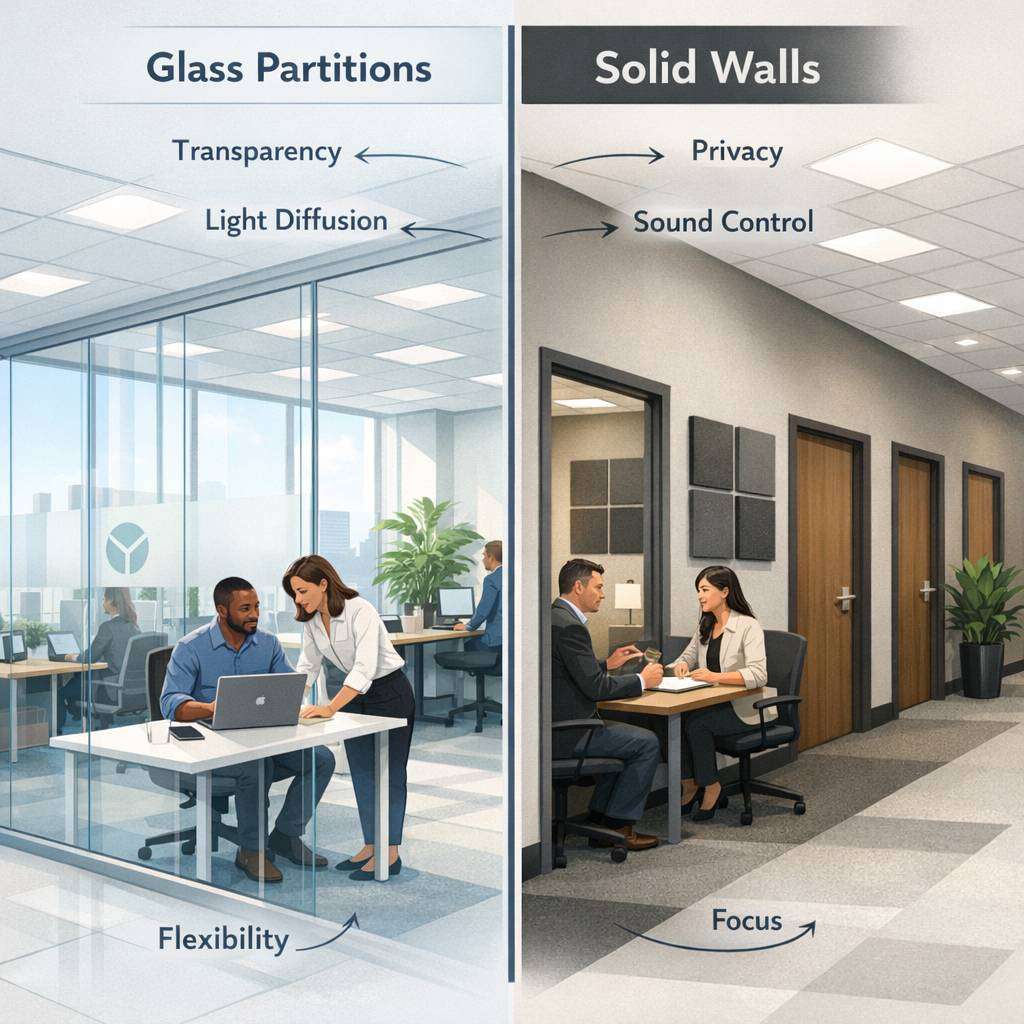
Choosing between glass partitions and traditional internal walls is a decision that shapes everything from acoustics and light to brand image and collaboration. As workplaces evolve, many organisations are moving away from opaque barriers in favour of transparent, flexible solutions. The right choice depends on your priorities—whether you value openness and daylight, or privacy and sound control. This guide outlines the key considerations, benefits, and practical implications of glass office partitions versus internal walls, helping you select the best fit for your workspace.
Benefits of glass office partitions
Glass office partitions offer several compelling advantages for modern work environments. They foster a sense of openness and transparency, which can boost communication and team cohesion. The natural light that passes through glass walls can reduce the need for artificial lighting, contributing to energy savings and a more pleasant atmosphere. Glass room dividers also create visually expansive spaces, making smaller offices feel larger and more welcoming to visitors.
Additionally, glass partitions convey a contemporary, professional image that many organisations use to reflect their brand values. If your business seeks to project innovation and collaboration, glass can be a strategic aesthetic choice. Practical features such as glass partition sliding doors enable easy access while maintaining an unobstructed flow of people and ideas.
Glass partitions and acoustics
A common concern with glass partitions is acoustics. While glass creates a sense of openness, it can transmit sound more readily than solid walls. However, there are engineered solutions to address this. Modern glass walls may incorporate laminated or double-glazed panes, acoustic seals, and tailored door hardware to reduce noise leakage. For spaces requiring greater privacy, you can opt for frosted or obscured glass on certain panels to provide visual privacy while still benefitting from light transmission.
In environments where privacy is critical, such as executive offices or conference rooms, semi-opaque or partly glazed configurations—sometimes described as half glass office partitions—offer a compromise. They preserve daylight and transparency in public zones while delivering enhanced privacy where needed.
Cost considerations
When evaluating glass office walls cost, it’s important to consider the total life-cycle cost, not just the upfront price. Initial installation for glass partitions can be higher than for standard stud-and-drywall systems, particularly if custom hardware or acoustic glazing is involved. Yet, energy savings from better daylight utilisation and reduced lighting requirements can offset some of these costs over time.
Maintenance expenses also vary. Glass wall exterior and glass wall outdoor components should be specified for weather resistance and durability, with robust seals and hardware to withstand commutes and cleaning regimes. In many cases, the durability and longevity of glass partitions can offer a favourable total cost of ownership when compared with traditional interior walls subject to ongoing repainting and refurbishment.
Interior flexibility and future-proofing
One of the strongest arguments in favour of glass room dividers is their adaptability. If your organisation is evolving—expanding teams, reconfiguring floors, or relocating departments—glass partitions tend to be easier to reconfigure than fixed internal walls. Demountable systems enable you to reposition, remove, or resize zones without significant structural work. This flexibility is especially valuable in rapidly growing or changing sectors such as technology, design, and marketing.
For projects with long-term scalability in mind, consider a modular glass partition wall system. These systems can be extended as space requirements shift, supporting a future-proof workspace strategy.
Aesthetics and branding
Glass partitions create a clean, contemporary aesthetic that can be tailored to your brand. Options such as glass partition sliding doors offer seamless access while maintaining a minimalist look. For external-facing spaces, premium glass wall exterior finishes can frame entryways and meeting rooms with a sense of openness that aligns with a brand’s ethos.
If line-of-sight into a meeting area is desirable for transparency, clear glass may be preferable. Conversely, for areas where confidentiality is essential, frosted or tinted glass, perhaps combined with timber or metal frames, can balance aesthetics with function.
Glass walls outdoors and external considerations
Expanding your design language to the exterior of the building—glass wall outdoor features—requires particular attention to weatherproofing, safety, and maintenance. External glass should meet fire and acoustic standards appropriate for the building type and location. It’s crucial to specify robust glazing, UV protection, and secure anchoring to resist wind loads and thermal expansion.
Even when exterior glass is used in interior courtyards or atriums, ensure that the design controls glare and heat. Insolation management can improve occupant comfort and reduce cooling loads. For entrances and circulation zones, consider hardened, low-maintenance glass with treated coatings that resist vandalism and scratches.
Glass partitions transform interiors by enhancing light flow, space perception, and privacy without heavy construction. For high-quality solutions visit https://www.urbansquare.net/, exploring durable glass partitions and modern layouts that elevate offices, studios, and retail environments with sleek versatility.
Privacy, security, and user experience
Hard-wearing internal walls excel at privacy, sound attenuation, and security. For teams requiring focused work, solid walls deliver superior acoustic separation and visual seclusion. They also enable you to install built-in storage, whiteboards, or integrated audiovisual systems without compromising on privacy or clutter.
When prioritising privacy without sacrificing daylight, hybrid solutions can be employed. A common approach uses glass partitions for public or semi-public spaces and solid partitions for privacy-critical zones. This hybrid strategy maximises light while preserving confidential areas.
Implementation challenges and best practices
- Plan for acoustic performance: Specify glass options with appropriate sound reduction to meet room-by-room requirements.
- Address maintenance: Choose easy-clean glass and durable frames; include accessible sealing for long-term performance.
- Align with IT and AV needs: Ensure adequate cable ingress, data ports, and power for meeting rooms and hot desks.
- Apply consistent detailing: Use uniform hardware finishes and edge treatments to maintain a cohesive look.
- Involve occupants early: Gather feedback from staff to balance transparency with privacy and comfort.
Conclusion: making the right choice for your workspace
While internal walls deliver unwavering privacy and strong acoustic separation, glass partitions offer light, openness, and flexibility that modern organisations often favour. The decision should hinge on your balance between daylight, collaboration, branding, privacy, and long-term adaptability. If you opt for glass partition walls, a well-designed system can provide excellent acoustics, ease of reconfiguration, and a contemporary aesthetic that resonates with today’s collaborative work culture. If you choose traditional internal walls, you gain predictable privacy, robust sound control, and a straightforward maintenance profile. In both cases, selecting quality materials, skilled installation, and careful planning will determine the success of your workspace transformation.